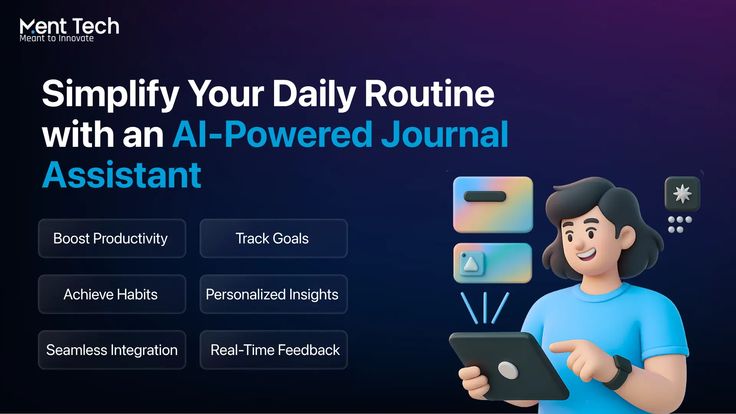
Intelligent Planners Are Changing the Way We Work
In a world overloaded with tasks, meetings, emails, and endless checklists, managing daily activities efficiently is a growing challenge. Traditional planners and digital calendars often fall short in adapting to shifting priorities, task complexity, and personal work styles. This is where AI-powered solutions step in—redefining productivity through intelligent automation.
Among the most transformative applications of AI technology today are journal assistants and AI daily planner tools. These systems go beyond scheduling—they learn from your habits, adapt to your routines, and help you optimize every hour of your day with precision. Built by forward-thinking AI development companies, these assistants are not only reshaping individual workflows but also revolutionizing how enterprises manage human productivity at scale.
Rethinking Productivity with AI-Powered Journal Assistants
Journal assistants are more than just advanced digital notebooks. These tools integrate AI technology to analyze daily behavior, prioritize activities, and adjust plans dynamically based on real-time inputs and changing conditions.
Unlike static to-do lists, AI-driven journal assistants can:
- Break down large tasks into smaller actionable steps
- Offer intelligent time blocking suggestions
- Monitor task completion rates and adjust future recommendations
- Align personal goals with organizational KPIs
- Integrate across platforms for seamless task tracking
These features make journal assistants ideal not just for individuals but also for teams looking to create harmony between productivity and adaptability.
Why Enterprises Are Turning to AI Daily Planners
The rise of AI daily planner tools within organizations reflects a shift toward intelligent productivity management. These planners are trained to understand natural language inputs, learn employee work habits, and recommend task schedules that reduce burnout and increase output.
Key enterprise use cases include:
- Streamlining employee workloads using contextual task suggestions
- Auto-prioritizing tasks based on urgency and impact
- Enhancing team collaboration through shared AI-managed boards
- Reducing decision fatigue by simplifying daily scheduling
The ability to act like a personal executive assistant—combined with scalability across hundreds or thousands of employees—makes AI-powered solutions an indispensable asset in today’s hybrid work environment.
The Role of AI Development Companies in Building Next-Gen Productivity Tools
Behind the scenes of every successful journal assistant or AI daily planner is a skilled AI development company. These companies specialize in integrating machine learning, natural language processing, and adaptive learning frameworks to create tools that don’t just follow instructions but anticipate user needs.
A top-tier AI development company ensures these tools remain:
- Context-aware, understanding the nuances of user behavior
- Secure and privacy-compliant for enterprise-grade deployments
- Continuously learning and improving from user feedback
- Capable of integrating with third-party APIs and enterprise systems
Whether you’re a startup founder looking to optimize your day or a large enterprise aiming to boost workforce efficiency, the right development partner can build and customize AI-powered solutions tailored to your unique challenges.
AI Technology That Learns and Adapts
The true power of modern AI technology lies in its adaptability. Unlike rule-based systems of the past, today’s AI learns in real time and evolves with usage. For example, if a user consistently misses morning tasks, the AI might begin suggesting later slots. If deadlines are regularly missed, the assistant could recommend buffer periods and proactive reminders.
These micro-adaptations form the core of intelligent productivity tools. As usage increases, the assistant becomes smarter—predicting behaviors, highlighting risks before they occur, and recommending the optimal path forward.
Adaptive benefits include:
- Smart reminders based on task complexity and time availability
- Pattern recognition to suggest routine automation
- Emotional and mental fatigue tracking through behavioral analysis
- Integrated insights from email, calendar, and messaging apps
This self-improving loop turns an AI daily planner into a reliable and proactive ally in everyday work.
Task-Specific Workflow Agents: Precision Over Generalization
Where traditional task managers fall short, task-specific workflow agents excel. These agents are purpose-built components within a larger AI-powered solution, each designed to handle specific categories of work.
Examples include:
- A content scheduling agent for marketing teams
- A bug tracking agent for developers
- A research logging agent for R&D departments
- A compliance checklist agent for legal or finance teams
These task-specific workflow agents work autonomously yet communicate with the core AI journal system to ensure continuity and coherence across tasks. This modular approach allows businesses to scale AI integration progressively—focusing on critical workflows first, then expanding.
Real-Time Benefits for Different User Roles
For Individuals:
- Regain control over daily priorities
- Reduce overwhelm through automated delegation
- Achieve better work-life balance with intelligent time boundaries
For Managers:
- Track team productivity without micromanaging
- Identify burnout risks early through behavior analytics
- Align team efforts with business goals using shared intelligent planners
For Enterprises:
- Boost ROI through efficiency and reduced human error
- Integrate with CRM, ERP, and project management tools
- Enable organization-wide AI-first productivity culture
From Scheduling to Decision-Making: The Expanding Role of AI Journal Assistants
The journey of journal assistants doesn’t stop at productivity enhancement. As these tools evolve, they’re stepping into decision-support roles. Advanced systems are now capable of:
- Providing data-backed suggestions for project timelines
- Highlighting dependencies across departments
- Offering “what-if” simulations for better decision outcomes
- Learning organizational workflows and automating repetitive decisions
This shift transforms AI from a passive scheduler to a proactive decision-making tool—an invaluable asset in fast-paced industries where agility and informed decisions define success.
Industry Applications: Where AI Daily Planners Are Making Impact
- Healthcare: Streamlining shift schedules for nurses and doctors, ensuring balanced workload
- Finance: Managing client follow-ups, reporting deadlines, and compliance calendars
- Education: Helping teachers and students track learning outcomes, syllabus progress, and class preparations
- Tech Startups: Automating scrum workflows, sprint planning, and bug triaging
- Law Firms: Organizing case-related tasks, court deadlines, and document submissions
In each of these cases, AI assists not just in time management but in operational clarity—bringing together people, tasks, and data into one intelligent workflow ecosystem.
Human-Centered AI: The Future Is Collaborative, Not Competitive
Despite concerns around AI replacing jobs, tools like AI daily planners and journal assistants highlight a different narrative—collaborative intelligence. These solutions don’t replace human decision-making; they empower it.
By automating the repetitive and optimizing the complex, AI tools free up mental bandwidth for creativity, critical thinking, and innovation. In other words, we’re not competing with AI—we’re partnering with it to do better work.
Conclusion
The rise of AI-powered solutions like journal assistants, AI daily planner tools, and task-specific workflow agents marks a significant leap forward in how we approach productivity. No longer just about ticking off to-do lists, the future of work is about intelligently managing time, energy, and priorities with the help of responsive, learning-driven systems.
Businesses adopting these tools today are gaining more than just efficiency—they’re building smarter, more adaptive work cultures. And at the heart of this shift are AI development companies crafting the frameworks that will define the next decade of intelligent work.
About Ment Tech
Ment Tech is a leading AI development company specializing in the creation of AI-powered solutions that transform productivity, decision-making, and digital workflows. From journal assistants to advanced task-specific workflow agents, Ment Tech helps enterprises across sectors harness the full potential of AI technology.
To explore customized AI integrations or build your own intelligent planner, connect with the Ment Tech team today.
 Site Title
Leave a comment